What are RBC Avion points?
RBC “Avion points” are the points currency earned on RBC Avion-branded credit cards (and certain other RBC products within the Avion Rewards ecosystem). The key reason Avion points are so popular in Canada is flexibility: you can book almost any flight through Avion Rewards, or you can transfer your points to airline programs for potentially higher value.
This guide focuses on travel redemptions (especially flights), since that’s where Avion points usually shine.
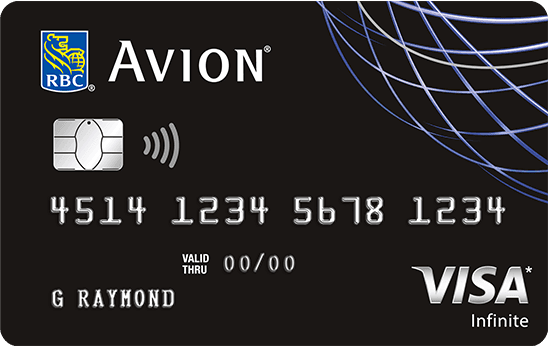
RBC Avion Visa Infinite
Annual fee: $120
up to 70,000 Avion points
- Earn 35,000 Avion points upon spending $0 in upon approval
- Earn 20,000 Avion points upon spending $5,000 in first 6 months
- Earn 15,000 Avion points upon spending $0 in one-year anniversary
- Up to 70,000 bonus Avion points welcome offer (up to $1,500 in travel value)
- Book any flight on 500+ airlines with no blackout dates or seat restrictions
- Unlimited emergency medical insurance — no trip-length cap
- Avion points never expire, giving you total flexibility
How much are Avion points worth?
Avion points don’t have one single value. Their value depends on how you redeem, and it’s best measured in CPP (cents per point).
Here are realistic CPP ranges you can use as a “valuation cheat sheet”:
-
Flexible Points Pricing redemptions via the Avion Rewards travel portal: 1.0 CPP. This is the bare minimum for many Avion cardholders when redeeming points toward travel through Avion Rewards, and as a whole we do not recommend using this option ever, especially since the below options are far better.
-
Fixed Points Pricing via the Avion Rewards travel portal: about 0.90 to 2.33 CPP
- Why the range is so wide: you always pay the same points for a category, even if the base fare is cheap.
- The top end happens when you redeem close to the maximum base fare in the category.
- In practice, many “good” schedule redemptions land around 1.60 to 2.00 CPP, with the absolute max being 2.33 CPP in the Quick Getaways category.
-
Transfer partners (estimated value of what you receive after transferring)
- British Airways Avios (1:1 transfer ratio): about 1.0 to 2.0 CPP. This range reflects what major points publishers commonly value Avios at (and it can be higher in premium-cabin sweet spots).
- Cathay Pacific Asia Miles (1:1 transfer ratio): about 1.2 to 1.6 CPP. Asia Miles can exceed these values on premium cabin redemptions, but this range is a practical “planning” estimate.
- American Airlines AAdvantage (10 Avion : 7 AAdvantage transfer ratio): about 0.9 to 1.35 CPP. AAdvantage itself is often valued around 1.30 to 1.90 CPP per mile by major publishers, but the weaker 10:7 transfer ratio reduces the effective value per Avion point. Again, premium cabin redemptions can make your CPP higher.
A quick rule:
- If you’re under ~1.0 CPP, you’re definitely leaving value on the table - don't do this.
- If you’re around 1.5+ CPP, you’re generally doing well.
- If you’re at 2.0+ CPP, that’s typically an excellent redemption for Avion points.
The 3 main ways to use Avion points for flights
1) Use the Air Travel Redemption Schedule (fixed points + ticket price cap)
This is the “fixed chart” option. You redeem a set number of points, and Avion covers a base airfare up to a maximum ticket price for that category. If your chosen flight costs more than the cap, you can pay the difference with more points (at a fixed rate) or pay cash.
This option can deliver excellent value when you find flights priced near the category’s maximum ticket price.
Air Travel Redemption Schedule (Economy, base airfare up to cap)
Round-trip categories:
| Category | Redemption (Points • Max base fare CAD) | Where it applies (high level) | Max CPP at cap |
|---|---|---|---|
| Quick Getaways | 15,000 • $350 | Adjacent province/territory or adjacent U.S. state | 2.33 |
| Explore North America | 35,000 • $750 | Canada/U.S. (excluding Hawaii/Alaska) | 2.14 |
| Holiday Destinations | 45,000 • $900 | West: Mexico/Hawaii/Alaska • East: Bermuda/Central America/Caribbean | 2.00 |
| Take a Vacation | 55,000 • $1,100 | East: Mexico/Hawaii/Alaska • West: Bermuda/Central America/Caribbean | 2.00 |
| Visit Europe | 65,000 • $1,300 | Major gateway in Canada/U.S. to Europe | 2.00 |
| See the World | 100,000 • $2,000 | Major gateway in Canada/U.S. to Asia/Oceania/Middle East/Africa/South America | 2.00 |
One-way categories:
| Category | Points (One-way) | Max base ticket price (CAD) | Max CPP at cap |
|---|---|---|---|
| Quick Getaways | 7,500 | $175 | 2.33 |
| Explore North America | 17,500 | $375 | 2.14 |
| Holiday Destinations | 22,500 | $450 | 2.00 |
| Take a Vacation | 27,500 | $550 | 2.00 |
| Visit Europe | 32,500 | $650 | 2.00 |
| See the World | 50,000 | $1,000 | 2.00 |
Important details:
- The “maximum ticket price” generally refers to base airfare and excludes taxes/fees/surcharges.
- If your flight is under the cap, you still pay the same fixed points for that category, which can lower your CPP.
- If your flight is over the cap, you can cover the extra using points at a fixed rate or pay cash.
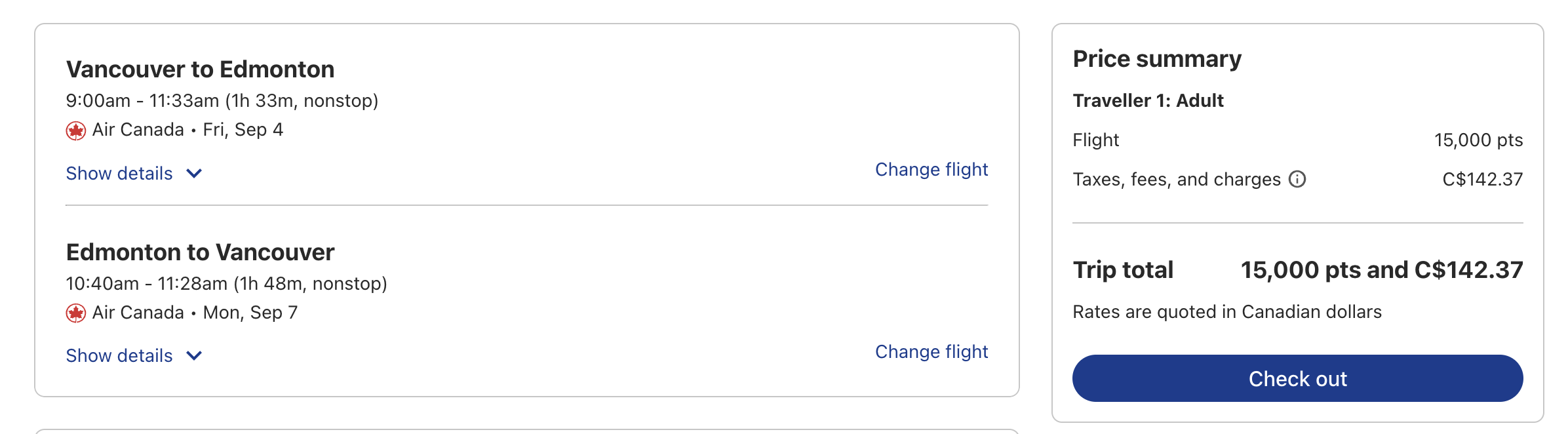
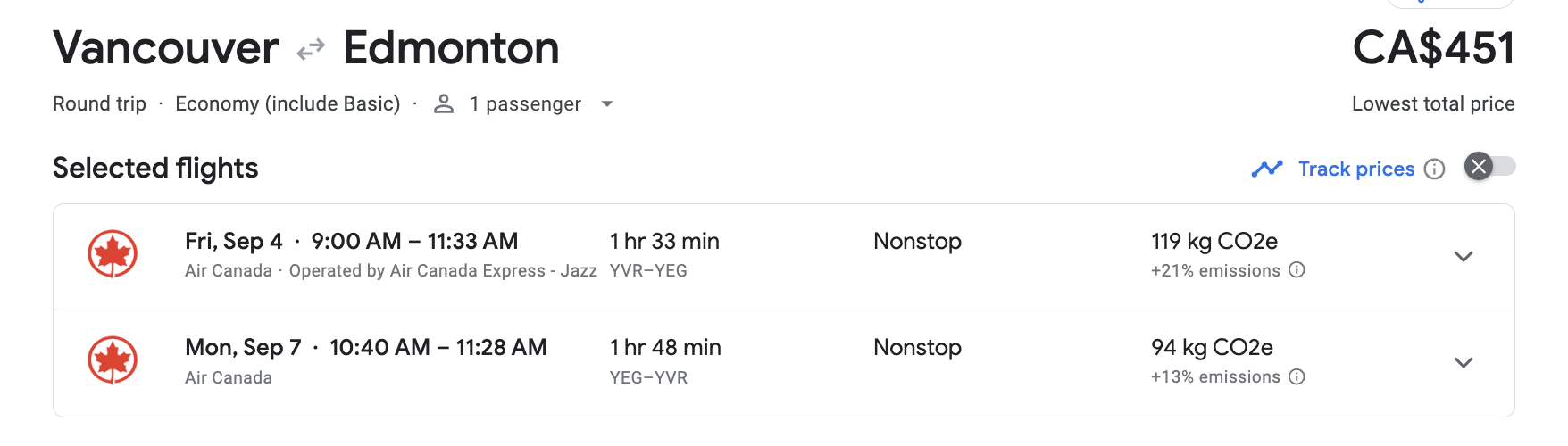
The above example represents a savings of $309 for using 15,000 Avion points, so a 2.06 CPP return, which is considered great.
2) Book travel through Avion Rewards at a fixed rate (100 points = $1)
If you don’t want to deal with the schedule caps (or your flight doesn’t price nicely under the caps), you can redeem for travel at a straight conversion rate. Unfortunately, this is usually one of your worst CPP options if you're looking to maximize the value of your Avion points.
For many Avion credit card holders, the standard travel redemption rate is:
- 100 points = $1 CAD toward travel (1.0 CPP)
You can use this for:
- flights (including when you don’t use the fixed schedule)
- hotels, car rentals, vacation packages, cruises
- taxes/fees/surcharges on flights
Note: Some RBC products can have different redemption rates, so always check your account’s rate before you redeem.
3) Transfer Avion points to airline programs (for “sweet spot” awards)
If you want the highest potential value, transferring points to airline programs is where Avion can become extremely powerful—especially for short-haul flights and premium cabins.
Common transfer options (eligibility can depend on your Avion membership level/card):
- British Airways Avios (often 1:1)
- Cathay Pacific Asia Miles (often 1:1)
- American Airlines AAdvantage (commonly 10 Avion : 7 AAdvantage miles)
- WestJet (conversion exists for eligible members; value depends on how you redeem in WestJet Rewards)
Transfers are typically one-way (irreversible), so you only want to transfer once you have a plan and you’ve confirmed award space.
When each flight redemption method is best
Here’s the practical way to think about it:
-
Use the Air Travel Redemption Schedule when you can find a flight whose base fare is close to the category maximum. That’s how you get close to the max CPP shown in the table.
-
Use 100 points = $1 travel redemptions basically never. Just know by using it you're doing it because:
- your flight is well below the category cap (so the fixed schedule would be “wasted”)
- you’re booking something that doesn’t fit the schedule cleanly
- you want simplicity and predictable value
- but really, you should be booking your flight with cash if this is the best option for your itinerary
-
Transfer to airline partners when:
- you’re booking short-haul flights (distance-based charts can be very cheap)
- you want business/first class without paying cash prices
- there’s a transfer bonus that boosts your conversion rate
Example redemptions using the Avion portal and schedule
The exact prices and taxes change daily, but these examples show how the math works so you can spot a good redemption fast.
Example A: Short-haul Canada/US “Quick Getaways” round-trip
Scenario:
- You find a round-trip flight priced with a base fare of about $345 (taxes/fees extra)
Option 1: Air Travel Redemption Schedule
- Redeem 15,000 points (covers up to $350 base fare)
- Pay taxes/fees with cash, or redeem additional points at about 1.0 CPP
At $345 base fare, your CPP on the base fare is:
- 345 / 15,000 x 100 = 2.3 CPP
If that same route is selling for a much lower base fare, the fixed schedule is usually not the best move because you’re still spending 15,000 points.
Example B: Canada/US cross-country “Explore North America” round-trip
Scenario:
- A Canada-to-Canada or Canada-to-US round-trip base fare is about $740
Option 1: Air Travel Redemption Schedule
- Redeem 35,000 points (covers up to $750 base fare)
CPP on the base fare:
- 740 / 35,000 x 100 = 2.11 CPP
Option 2: 100 points = $1
- To cover about $740, you’d redeem about 74,000 points (1.0 CPP)
In this scenario, the fixed schedule tends to be dramatically better.
Example C: Flight above the schedule cap (using “top-up” points)
Scenario:
- Your category cap is $750, but your flight base fare is $890 (so you’re $140 over)
How it prices:
- Redeem the fixed amount for the category (example: 35,000 points)
- Cover the extra $140 in one of two ways:
- pay $140 cash, or
- redeem an extra 14,000 points at 1.0 CPP
This “hybrid” approach can still be worthwhile if the base fare is close to the cap and you don’t mind topping up.
Transfer partner example redemptions (Avios, Asia Miles, AAdvantage)
Transfer partners are where you can sometimes beat the portal by a lot, but the tradeoff is:
- award availability can be limited
- you still pay taxes/fees (and sometimes meaningful surcharges)
- transfers are typically not reversible
British Airways Avios: short-haul sweet spots, or premium cabins
Avios pricing is commonly distance-based, which can make short flights surprisingly cheap in points.
How this can beat the portal:
- If a short flight costs a lot in cash (especially last-minute), distance-based awards can undercut portal pricing by a wide margin, even after taxes.
Avios transfer bonus history
RBC regularly runs limited-time promos where your Avion → Avios transfer gets a 30% uplift (10,000 Avion → 13,000 Avios). These bonuses happen roughly 1–2 times per year, and they can meaningfully increase your effective CPP since you receive more Avios for the same Avion points.
Here's every verified bonus from the last 3 years:
| Promo window | Bonus | Effective rate |
|---|---|---|
| Apr 3, 2023 → May 15, 2023 | 30% | 1:1.3 |
| Oct 2, 2023 → Nov 13, 2023 | 30% | 1:1.3 |
| May 7, 2024 → Jun 21, 2024 | 30% | 1:1.3 |
| Oct 1, 2024 → Nov 12, 2024 | 30% | 1:1.3 |
| Jun 2, 2025 → Jul 11, 2025 | 30% | 1:1.3 |
| Nov 10, 2025 → Dec 19, 2025 | 30% | 1:1.3 |
The pattern: expect a spring/summer window and a fall/holiday window each year. All bonuses so far have been exactly 30%. For a deeper breakdown of how to time your transfers and when the bonus is actually worth using, see our RBC Avion → Avios Transfer Bonus Guide.
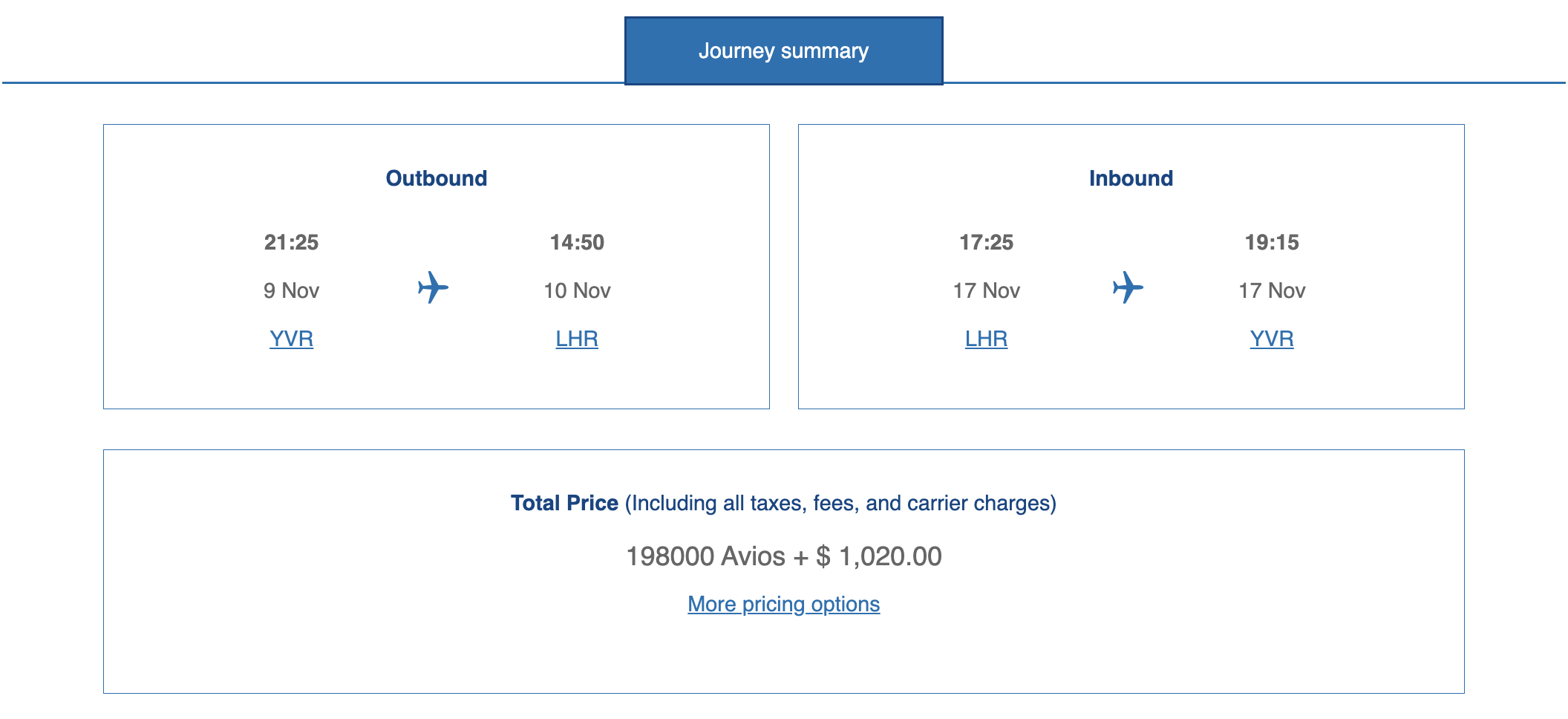
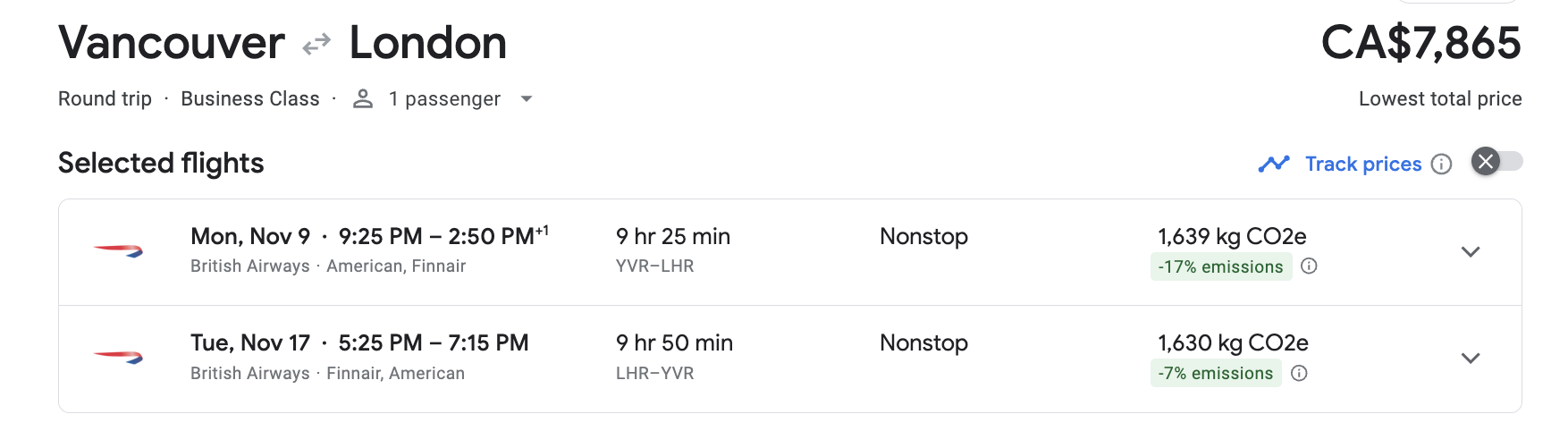
The top image shows British Airways' redemption portal, and the bottom one shows the Google Flights cost for the same flight. That works out to a savings of $6845 by using 198,000 Avios points, so an outsized value of 3.45 CPP! These outsized values are common if you can find premium cabin availability with partners such as British Airways.
Cathay Pacific Asia Miles: strong options for premium cabins and oneworld awards
Asia Miles is often interesting for premium cabin redemptions and certain partner awards, but you’ll want to compare:
- points required for your route
- expected taxes/fees/surcharges
- award availability on your specific dates
There are occassionally also Asia Miles transfer bonusses (typically a 15% bonus) that happen once per year, so keep an eye out for that.
American Airlines AAdvantage: useful, but the transfer ratio is weaker
Avion can convert to AAdvantage, but at a less generous rate than 1:1. That means you generally need a strong AAdvantage redemption to justify the transfer—often when you’re topping up an existing AAdvantage balance for a specific award.
Avion points for hotels
Hotels are typically the “easy mode” redemption inside the Avion Rewards travel portal. Because there are better ways to get higher than 1 CPP, we don't recommend doing this.
How it usually works:
- You search hotels inside Avion Rewards (similar to how you’d use other online travel agencies).
- You apply points at the fixed travel rate during checkout (commonly 1 CPP).
- You can cover the entire booking with points or do a points + cash mix.
When hotels make sense (outside of basically never if you want to maximize CPP):
- You want a straightforward, predictable redemption without worrying about flight caps or award availability.
- Hotel prices are unusually high (peak weekends, major events) and you’d rather use points than pay cash.
Things to keep an eye out for:
- Hotel bookings through portals can sometimes earn fewer (or no) hotel loyalty points and may not qualify for elite benefits, depending on the chain and how the booking is processed.
- Always compare the portal price to booking direct. Even if you’re using points, you still want the best base price.
How to transfer Avion points to another person
RBC doesn’t offer a simple “gift Avion points to any other Avion member” feature. Avion transfers are designed primarily for moving points between eligible points accounts you own (i.e., accounts that show up on your Avion profile).
That said, there are two real-world ways Canadians can still “share” Avion points with a partner or family member.
Option 1: Make them a co-applicant (so they can redeem the points)
If your goal is simply “let my partner use the points,” the cleanest solution is adding them as a co-applicant on your eligible RBC Avion credit card.
How it works:
- A co-applicant is a joint borrower on the credit card account.
- Co-applicants can redeem Avion points earned on that account.
- This is different from an authorized user, where purchases may earn points but the points remain in the primary applicant’s name and the authorized user can’t redeem them.
When this is best:
- You want the simplest setup and don’t care whose name the redemption is under.
- You want both people to be able to log in and redeem points from the same credit card account.
Important notes:
- Adding a co-applicant means shared liability for the balance.
- There’s typically a maximum of one co-applicant per credit card account.
Option 2: Use a joint RBC account as a “bridge” to move points between two people
If each person has their own Avion-earning product and their own Avion balance, the practical way to move points from Person A to Person B is to use an eligible joint RBC banking account as the shared link between you.
ou create/maintain a joint RBC account that both of you own, then transfer points into that joint account, and then out to the other person’s eligible points account.
Why this works:
- With certain eligible banking rewards accounts, points can be accessed/managed by the Primary Account Owner and Joint Account Owner.
- Avion’s transfer tool lets you move points between eligible accounts that appear on your profile, and RBC’s program terms describe transfers from a rewards account to other eligible rewards accounts tied to accounts owned by the primary/joint owners.
Step-by-step (the “joint account bridge” method):
-
Make sure you share an eligible joint RBC banking account
- Both people must be joint owners on the account.
- If the account is eligible to earn/hold Avion points, it can act as the shared “pool.”
-
Link everything to Avion Rewards
- Each person should have their own Avion Rewards login/profile.
- Your eligible products (credit card + banking rewards account) need to show up under your Avion profile so they appear as transfer options.
-
Transfer points from Person A → the joint account
- Log in to Avion Rewards.
- Go to the Transfer menu.
- Choose Transfer Now.
- Select Person A’s points account as the “From” account, and the eligible joint banking rewards account as the “To” account.
- Enter the number of points and submit.
-
Transfer points from the joint account → Person B
- Person B logs in to Avion Rewards.
- Go to Transfer → Transfer Now.
- Select the joint account as “From,” and Person B’s eligible points account as “To.”
- Enter the number of points and submit.
What to expect when transferring:
- Transfers are typically 1:1, with no fee.
- There’s usually no minimum or maximum transfer amount.
- If you transfer to the wrong eligible account, you generally can’t “cancel” the transfer—but you can usually transfer again to move the points where you intended.
Key Notes About Transferring to Another Avion Account
-
Authorized user / supplementary cardholder: purchases may earn points, but those points belong to the primary applicant and the authorized user can’t redeem them.
-
Sending Avion points to a random friend’s Avion account: Avion’s own FAQs describe transfers as being between points accounts you own (i.e., on your profile), not a general member-to-member gift feature.
-
Want your partner to be able to redeem points from one shared pool?
- Use Option 1 (add as co-applicant).
-
Want to move points from Person A’s Avion balance to Person B’s Avion balance?
- Use Option 2 (joint account bridge), if you have an eligible joint RBC account that can hold/transfer Avion points between your eligible products.
Other ways to redeem Avion points (and when to avoid them)
Avion points can be redeemed for many non-travel options (gift cards, merchandise, statement credits, etc.). These can be convenient, but they’re often lower value than travel redemptions—especially compared to the fixed schedule or good transfer-partner awards.
If your goal is maximum travel value, you’ll usually treat non-travel redemptions as a last resort.
Pro tips to get more value from Avion points
-
Aim to “maximize the cap” on the Air Travel Redemption Schedule for Fixed Points. The closer your base fare is to the maximum ticket price, the better your CPP.
-
Check transfer bonuses before you move points. RBC runs Avios transfer bonuses roughly twice a year (typically 30% extra), which can instantly change what's "best."
-
Always confirm award space before transferring points. Once points move to an airline program, you can’t move them back.
-
Consider taxes, fees, and surcharges in your value calculations. A redemption can look great in points but still carry heavy cash surcharges on certain airlines/programs.
Quick decision checklist
-
Is your flight’s base fare close to a schedule cap?
- Yes → use Air Travel Redemption Schedule
- No → compare fixed travel rate vs transfer partners vs booking with cash
-
Are you booking business class?
- Compare: (1) schedule + top-up points, (2) transfer partners, (3) any promo bonuses
Bottom line
RBC Avion points can be extremely useful for travel, but the “best” method depends on the trip:
- For many Canadians, the Air Travel Redemption Schedule is the highest value option when you can find base fares near the cap.
- The fixed travel rate is the reliable, flexible fallback for flights, hotels, and often other travel bookings, but it comes at a bad value per point.
- Transfers to airline partners can unlock outsized value—especially for short-haul flights and premium cabins—if you can find award availability and keep fees reasonable.